Your Brain is a Distributed System

I am an International Coaching Federation-certified life coach at the ACC level, as well as a Professor at Westminster University. I completed my coach training at Coach U, and my PhD in Mathematics at the University of Chicago. I founded Inner Harmony Coaching in 2020. I help women find their authentic voice, believe in themselves, and succeed.
As a society, we are trained – and continually retrained – to rely on analytical thinking. Nearly all of our schooling reinforces it, while gradually training us away from acting on our feelings. Children are told to “use your words.” As a mathematician, I’m certainly not going to argue against analytical thinking. It is a vital part of human intelligence. But we consistently neglect to teach people to think with their bodies, too.
As it turns out, the brain in your head is only one part of your sense-making system. The gut and heart also contain what could be called brain cells. The enteric nervous system in the digestive tract is sometimes called the body’s second brain, and the heart contains neurons as well. Information from these organs travels back to the analytical brain via the vagus nerve, a two-way communication highway linking your body and mind. When we don’t know how to listen to our bodies, we lose access to a significant part of our own intelligence.
The Case for Interoception
To take advantage of all this extra processing power, you need to develop interoception, the ability to perceive internal signals from your body.
Research shows that people with stronger interoception have better self-regulation, greater emotional awareness, and tend to make better decisions. They’re even less likely to gamble. In other words, tuning into your “gut feelings” alongside rational thought actually improves outcomes.
One common measure of interoception is whether you can feel your own heartbeat without touching your body or taking your pulse. But it shows up in subtler ways too: Do you notice when your gut clenches under stress? Do you always recognize when you’re hungry, or cold?
Many of us can’t access those signals at all, or only with great effort. People in analytical fields like mathematics are especially prone to this, largely because of how we’re educated. I used to believe that any evidence not produced by my rational mind was simply inadmissible – invalid in the court of life. Listening to my gut felt completely out of reach.
But it wasn’t. And it isn’t for you, either.
Feelings vs. Emotions
Here’s something I didn’t know until relatively recently: emotions and feelings are not the same thing.
Emotions are physical sensations – the clenching of a stomach, the pressure of tears, an elevated heartbeat. Feelings are our interpretation of those sensations: nervous, sad, excited. When your interoception is well developed, you can detect your emotions first. You then link them to feelings. Which feelings you land on depends on your personal history, cultural background, and beliefs. The clearer your access to your emotions, the more accurately you can name what you’re feeling.
Can You Develop Interoception?
Yes -and you don’t need to become a seasoned meditator to do it. You simply have to begin paying attention.
Start small. Notice how your hands feel right now. Is your breathing even or shallow? Over time, you’ll notice more. At first it may feel uncomfortable; the moment you try to sit quietly with yourself, you might feel a strong urge to check your phone or tackle a chore. When that happens, take a slow breath, remind yourself that discomfort is okay, and try again. It gets much easier.
The Inner Shepherd Technique
My own journey began in graduate school, when I realized I had suppressed my feelings for so long that they simply no longer surfaced. I couldn’t tell when I was anxious or sad. So I developed a technique – one I thought was quirky and personal – but when I shared it with the women at the Resilience Roundtable, it resonated deeply. They encouraged me to share it here.
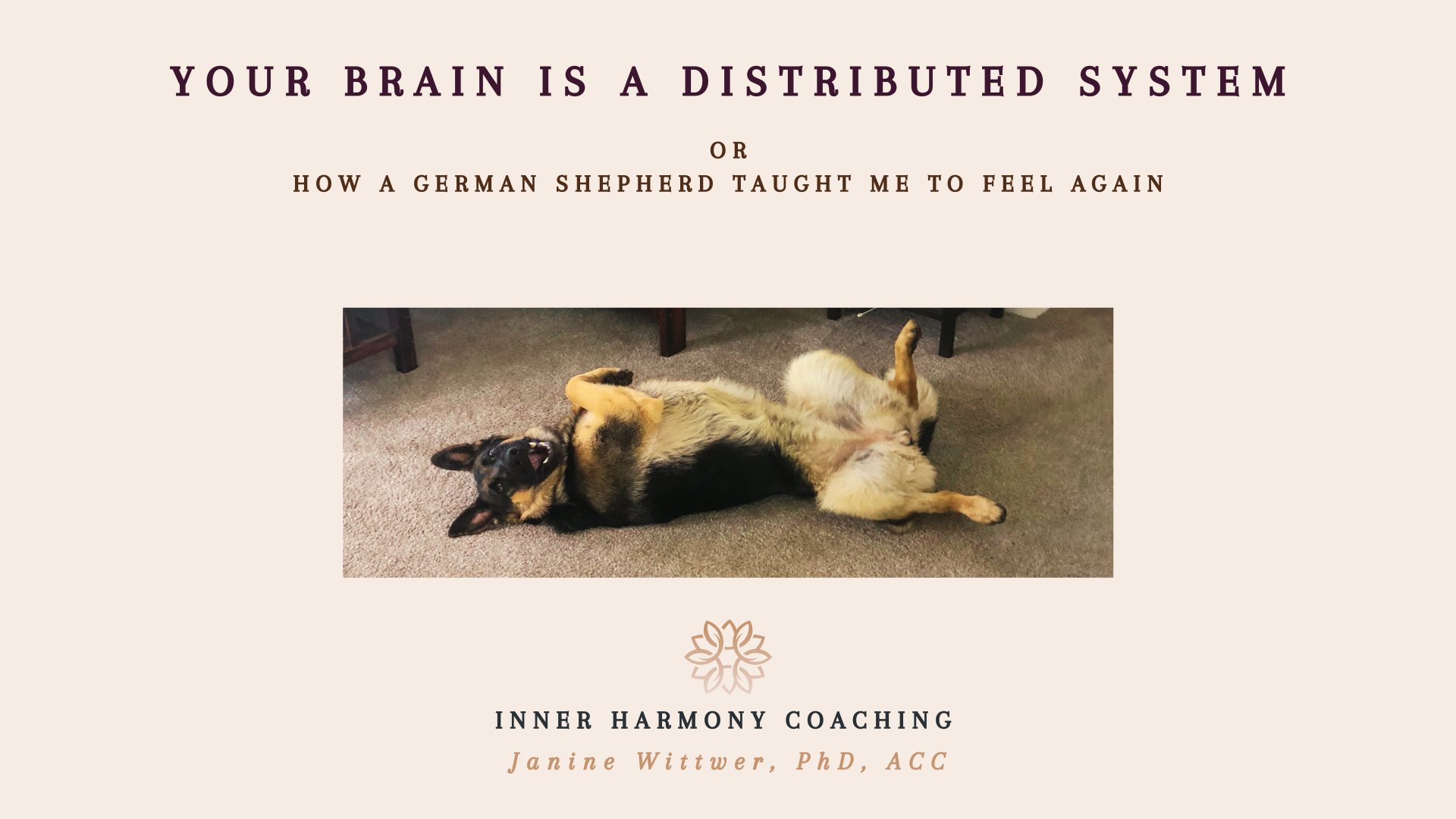
I grew up with German Shepherds. As a kid, I always imagined that if I were an animal, that’s what I’d be. So when I struggled to identify how I was feeling, I began to visualize myself as a German Shepherd and observe its body language. If it was pacing and whining, I knew I was anxious. If it was curled up and calm, I could trust that feeling too. I’ve come to call this the Inner Shepherd Technique.
I’m much better at identifying my feelings now, but I still return to my inner shepherd when I want to fine-tune my understanding of something. It’s a small technique, but it opened a door I didn’t know was closed.
If you try it, I’d genuinely love to hear how it went (or didn’t). I’m gathering responses to understand how I can make it most useful to others.
More Standard Techniques
If you’d like to explore further, the body scan is a wonderful place to start. It is a practice where you move your attention through each part of the body in turn. UCLA Health offers a free three-minute guided version online, and it doubles as an effective stress-reduction tool.
While you don’t need a meditation practice to develop interoception, mindfulness meditation is certainly an effective way to get here. If you’re motivated to go deeper, I recommend the MBSR (Mindfulness-Based Stress Reduction) course, an eight-week program that can genuinely change your life. I loved it so much, I took it three times. A free version is available at palousemindfulness.com. I haven’t personally worked through this particular version, but it receives strong reviews and appears to follow the standard curriculum.
Join the Resilience Roundtable
The Resilience Roundtable is a free weekly Zoom group for women, held every Wednesday at 12:00 pm MT. Each week we explore topics like emotional intelligence and evidence-based strategies drawn from coaching and neuroscience – and we support each other along the way.
If you identify as female and would like to join, send me an email at Janine@InnerHarmonyCoaching.com and I’ll add you to the group.